Hieronymous Gleister’s suicide and the Gleister cycle
The Robot Who Looked Like MeHieronymous Gleister’s suicide and the Gleister cycle turns a paradox of time travel into an escalating population crisis: every journey produces another Gleister, and every new Gleister can generate still more. When the Emperor’s resources fail to keep pace with the geometric growth, Hieronymous argues that only a death outside the ordinary sequence of time tracks can make the process terminate. The episode then moves from that argument to Charlie Gleister’s suicide and an immediate return to imperial life, making death not a clean escape from the cycle but the mechanism by which its roles are recycled.
How the Cycle Multiplies
The explanation begins with the first Gleister, called the original or Ur-Gleister, building a time machine and traveling into the future. His absence leaves a gap in the space-time fabric; Nature fills it with an identical or nearly identical Gleister. This replacement is not a one-time correction. Every later use of a time machine creates another displacement, and Nature supplies another Gleister to occupy the vacancy.
Those new arrivals do not simply duplicate one fixed life. They move through different sequences and missions: one sequence becomes the Emperor, another forms an organization against him, and other sequences branch away as well. Because each time-traveling Gleister helps bring further Gleisters into being, the process feeds on itself. The account describes the result as geometric growth: hundreds become thousands, then millions, and eventually vastly greater numbers. The central danger is therefore not any single Gleister’s actions, but the structure that makes each journey a source of further journeys and further duplication.
An Empire Overrun
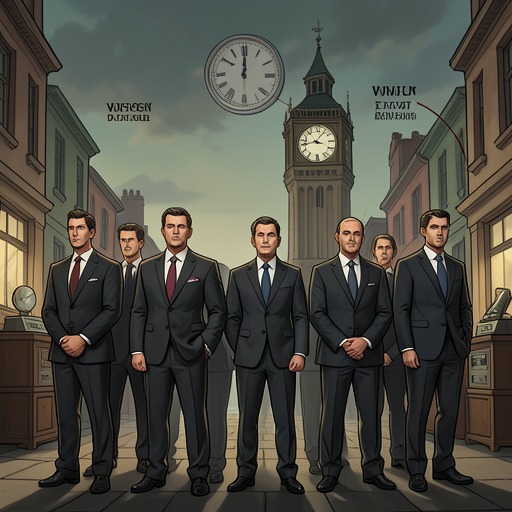
The Gleisters have nowhere else to go, so they arrive in the Emperor’s domain. Emperor Mingus says he has housed about twelve million of them, but the Empire is running out of resources as new arrivals come faster. The number gives the crisis a concrete scale: this is already a burden of millions, not a distant possibility or a small administrative inconvenience.
Ordinary force cannot solve it. Emperor Mingus considers the Army shooting Gleisters on sight, but recognizes that killing individuals would not control a progression that continually produces more. His forecast is of an Earth carpeted in Gleisters, with new ones still pouring in. The crisis also reaches the Emperor personally: he is responsible for managing the population even though he cannot command the process that creates it. The idea that the Emperor is the slave of time follows from this reversal. Imperial authority can house the consequences temporarily, but cannot stop the temporal mechanism producing them.
The Proposed Limit
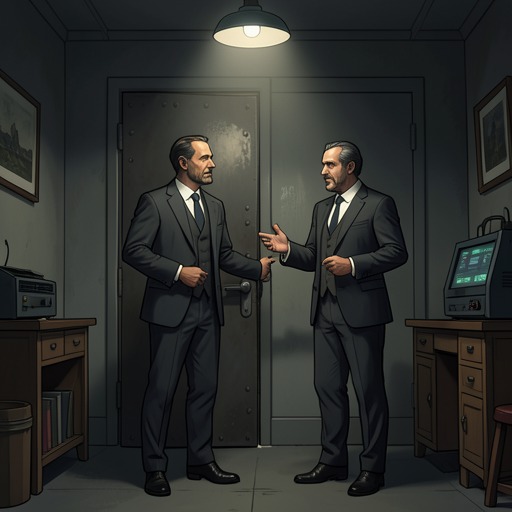
Hieronymous frames the problem as an infinite expansion that must be given a limit if it is ever to terminate. In his reasoning, death is the only natural limit capable of entering the series early enough to grow alongside it and eventually cancel it. Emperor Mingus objects that Gleisters have already died without slowing the expansion. Hieronymous distinguishes those deaths from the one he proposes: the deaths so far have been normal endings of individual time tracks, whereas the cycle requires an early death outside continuity, a suicide.
At first Emperor Mingus accepts the idea as a possible final imperial act. Hieronymous refuses to let the burden fall on him, arguing that the death must occur as early as possible in a young Gleister’s time track. When the Emperor suggests drawing lots among younger Gleisters, Hieronymous insists that it must be him. He believes, on intuition rather than demonstrated proof, that he is the original Gleister, and therefore that only his suicide can end what he began. The decision combines a proposed causal solution with a claim about identity: the person who believes he began the process also believes he must supply its terminating event.
Suicide and Recycling
After Hieronymous has pushed the button and disappeared, the narrative shifts to Charlie Gleister in Harvest Falls, Indiana, on a beautiful September afternoon. Charlie passes Apple Street and the white frame house that once held his laboratory. He considers going inside to speak with himself, then decides he has had enough of Gleisters. Instead, he leaves town along Route 347, crosses a stubbled field, passes through woods, and reaches the brook where he used to fish as a boy. The familiar landscape places the extraordinary temporal crisis against the remembered details of an ordinary life.
Sitting with his back against a large oak, Charlie takes out a gun. He appears numb and self-conscious; he rubs his nose and looks at sunlight on the water before deciding to act. He puts the muzzle in his mouth, gags at the oily-metal taste, closes his eyes, pulls the trigger, and dies. The scene does not present the act as an abstract proposition: its pauses, bodily hesitation, and remembered setting give the proposed limit a specific human cost.
The sequence immediately labels what follows as the initial termination recycling. Charlie opens his eyes in the imperial audience room, where the latest figures report that more than twelve million Gleisters have been settled and more are arriving every minute. He hands a laser gun to the young Egon Gleister, who presses the button on his time machine and leaves. Charlie is now Emperor, and understands that he and the others must take turns occupying the Gleister roles as the termination proceeds. The cycle does not simply erase the population; it rearranges its participants and returns Charlie to imperial duty.
The Cycle’s Ending and Meaning
Charlie recognizes that he, like the others, will have to perform all the roles, until at the end only he remains, as at the beginning. Even the suicide is not permanently behind him: he is grateful to have completed that part for now, but expects to do it again after the others have done it. The ending thus makes termination recursive. Death may initiate recycling and hold out the prospect of an eventual end, but the immediate result is not release; it is another turn through the same system.
The sequence also leaves a deliberate tension between Hieronymous’s intuition that he is the original and Charlie’s return as the figure who is both Emperor and, in the end, alone at the beginning. Rather than resolving identity into a simple line of descent, the cycle folds origin, consequence, and repeated role into one another. Its sharpest irony is that an attempt to stop duplication requires one Gleister to die, yet the first visible consequence of that death is a renewed imperial scene, complete with fresh statistics, another departing time traveler, and the expectation that the part will have to be played again.